

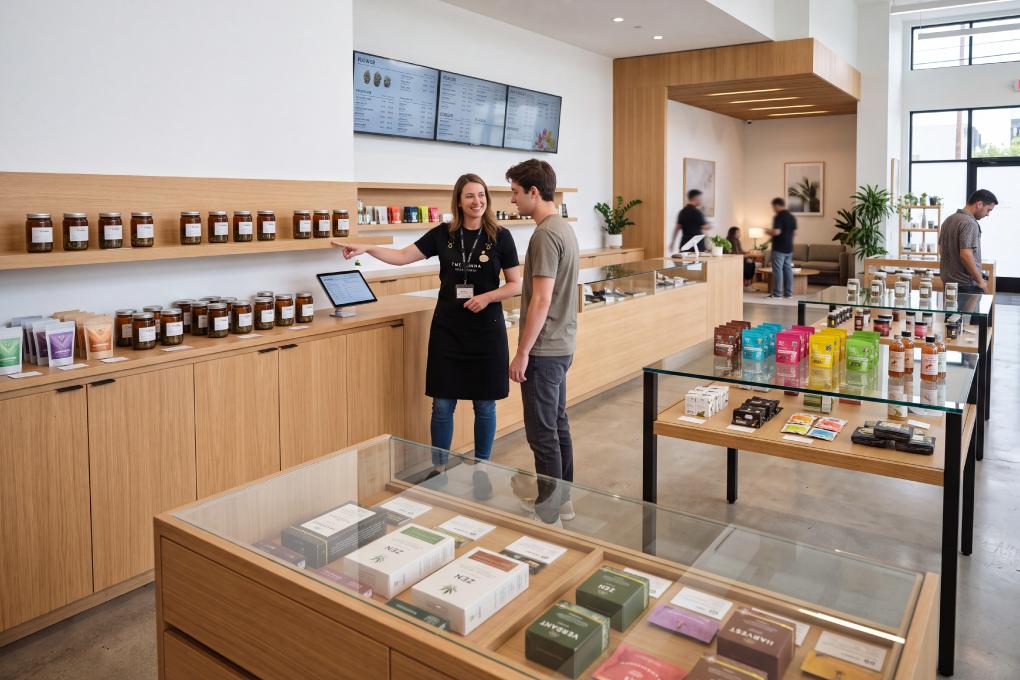
Walk into a modern licensed dispensary and the experience may feel increasingly familiar. Products are organized by category. Staff use point-of-sale systems and inventory tools. Customers browse digital menus, place orders online, join loyalty programs, receive educational guidance, and expect convenient service. Cannabis retail remains heavily regulated and legally distinct from conventional commerce, but many of its customer-experience strategies now resemble those used across mainstream retail.
This transition is a sign of market maturity. Early cannabis businesses often focused on obtaining licenses, maintaining compliance, and simply meeting demand. As competition increased and consumers gained more options, retailers had to think beyond access. They began investing in store design, branding, staff training, technology, retention, data, and convenience.
The result is not that cannabis has become an ordinary product. Age restrictions, state tracking, advertising limits, product rules, and federal conflicts still shape every transaction. Rather, cannabis retailers are adopting proven retail practices while adapting them to one of the country's most complex regulated markets.
In the early stages of many state markets, legal access itself was the main attraction. Consumers had a limited number of licensed locations, and businesses could often rely on demand created by a new program.
As markets developed, access alone stopped being enough. Customers began comparing stores based on selection, pricing, convenience, staff knowledge, atmosphere, and trust. Retailers had to create reasons for consumers to return.
This mirrors the development of other retail categories. Once shoppers have several acceptable options, experience becomes a competitive factor. Cannabis retailers now work to make shopping organized, informative, and predictable while still following strict compliance requirements.
Modern dispensary design can include welcoming reception areas, organized display zones, consultation spaces, digital screens, secure fulfillment areas, and efficient checkout stations. The exact layout depends on local regulations, building constraints, customer volume, and business strategy.
Design is not only about appearance. It affects traffic flow, privacy, security, accessibility, product education, and transaction speed. A well-planned store helps customers understand where to go and what to expect.
Traditional retailers have long used layout to reduce friction and support discovery. Cannabis stores are applying similar thinking while accounting for identity verification, limited-access areas, surveillance, and controlled product handling.
For many consumers, the shopping experience begins online. They search for nearby businesses, compare hours, browse menus, check availability, and research products before leaving home. A dispensary's digital menu can therefore function as its most important storefront.
Consumers expect menu information to be accurate. They want current inventory, clear categories, useful descriptions, pricing, and product details. When an online menu lists unavailable products or lacks basic information, trust can decline before the customer arrives.
Retailers increasingly connect e-commerce interfaces with inventory and point-of-sale systems to reduce mismatches. Integration is difficult because cannabis inventory must also align with state-mandated tracking. Still, the expectation is moving toward a connected experience in which online browsing and in-store purchasing feel like parts of the same journey.
Traditional retail has trained consumers to expect choice in how they shop. Cannabis retailers are responding with online ordering, scheduled pickup, curbside service where allowed, and delivery in jurisdictions that permit it.
These options can reduce wait times and help customers plan purchases. They also create operational challenges. Staff must keep inventory accurate, verify identity, follow purchase limits, prepare orders securely, and document transactions correctly.
Convenience cannot come at the expense of compliance. The strongest systems make legal requirements feel integrated rather than burdensome to the customer.
Loyalty programs are common across grocery, hospitality, beauty, and specialty retail. Cannabis businesses use them to encourage repeat visits and understand customer behavior, subject to privacy and marketing rules.
Modern programs may offer points, tiered rewards, member pricing, birthday offers, early access, or educational communications. The value depends on whether customers understand the program and can use benefits easily. Complicated rules or inconsistent redemption can undermine trust.
Recent cannabis retail benchmark reporting has shown how important loyalty members can be to dispensary revenue, although results from a vendor dataset should not be assumed to represent every store. The broader lesson is consistent with traditional retail: retention can be more efficient than constantly acquiring new customers.
Point-of-sale and loyalty systems provide retailers with information about sales, category performance, basket size, visit frequency, promotions, and inventory movement. Businesses use these records to plan purchasing, staffing, merchandising, and communications.
Data can help a retailer identify products that sell steadily, items that remain on shelves too long, and promotions that produce repeat business rather than one-time discount traffic. It can also reveal differences between locations or customer segments.
Responsible data use matters. Consumers should understand what information is collected, and businesses must follow applicable privacy, communications, and security requirements. Personalization should improve service without becoming intrusive.
Traditional retailers organize products to make choices easier. Cannabis retailers increasingly group inventory by format, brand, price, cannabinoid content, intended occasion, aroma, or other lawful descriptive attributes.
Good merchandising helps consumers navigate a large menu. It can highlight new products, explain differences, and support discovery without making unsupported health claims. Digital and physical merchandising should remain consistent so customers are not confused when they enter the store.
The challenge is balancing sales strategy with responsible education. A display should not encourage overconsumption or imply guaranteed effects. Clear information is more sustainable than hype.
Cannabis retail employees work in a specialized environment. They need customer-service skills, product knowledge, compliance awareness, and the ability to communicate without practicing medicine or making unsupported promises.
Training may cover identity verification, purchase limits, point-of-sale procedures, product categories, labels, serving sizes, responsible-use messages, privacy, security, and incident response. Managers also need coaching, scheduling, inventory, and performance-management skills found throughout retail.
Knowledgeable staff can reduce confusion for new consumers and help experienced shoppers compare products. Consistent training is essential because inaccurate statements can create legal, safety, and trust problems.
Consumers experience a retailer through search results, business listings, social content, email, websites, menus, packaging, staff interactions, and post-purchase support. Traditional retailers work to keep these touchpoints consistent, and cannabis businesses increasingly do the same.
Consistency includes accurate hours, matching prices, clear policies, recognizable design, and a dependable tone. If online information conflicts with the store experience, customers may question the business's reliability.
Platforms such as GanjaTrack support this broader discovery environment by helping consumers find businesses and information in an organized format. Retailers benefit when their listings and details are current because digital discovery often determines which location a consumer visits.
Discounting has long been used to attract cannabis shoppers, but constant promotions can reduce margins and train customers to buy only when prices fall. Mature retailers are becoming more selective.
They may use promotions to introduce a category, move aging inventory responsibly, reward loyal customers, or increase traffic during slower periods. Performance data can help determine whether a promotion generated profitable repeat behavior.
Advertising restrictions complicate this work. Retailers must follow state and local rules concerning audience age, message placement, claims, and promotional structure. Traditional retail tactics cannot simply be copied without legal review.
Retail inventory management always involves forecasting, receiving, storage, shrink control, replenishment, and aging. Cannabis adds mandatory tracking, purchase limits, quarantine procedures, testing status, and product-specific compliance rules.
Retailers must reconcile physical inventory with internal systems and state databases. Errors can create customer frustration and regulatory risk. Products also have different storage needs and shelf lives, making stock rotation important.
Integrated systems and disciplined procedures help retailers maintain accurate menus and reduce waste. This operational work is mostly invisible to consumers, but it determines whether the promised product is actually available.
One area where cannabis has not fully matched traditional retail is financial services. Federal legal conflicts have limited banking and payment options for many businesses. Cash remains common, while compliant debit, automated clearing house, and other solutions vary by operator and jurisdiction.
Consumers increasingly expect familiar payment experiences, but retailers must evaluate legal, banking, security, fee, and reliability considerations. A payment method that looks convenient is not automatically compliant or sustainable.
This gap demonstrates the central reality of cannabis retail: the customer experience may look mainstream while the underlying legal and financial structure remains unusual.
Traditional retail practices are useful only when they fit cannabis rules. Licensed retailers must maintain age controls, secure product storage, surveillance, inventory records, employee credentials, packaging compliance, and transaction limits as required.
They also have a responsibility to communicate impairment warnings and responsible storage. Products containing THC should be kept away from children and pets, and consumers should understand serving sizes and delayed effects where relevant.
A polished store cannot replace compliance. In cannabis, professionalism means combining convenience with disciplined legal and safety practices.
Retailers that meet these expectations create value beyond discounts.
Cannabis retailers are becoming more like traditional retailers because consumers compare them with every other modern shopping experience. A slow website, inaccurate menu, unclear loyalty program, or disorganized store feels outdated regardless of the product category.
At the same time, copying mainstream retail without understanding cannabis rules is risky. Businesses need technology, data, design, and customer service, but they also need compliance expertise and state-specific operations.
The competitive advantage belongs to retailers that connect these disciplines. They make shopping easier while maintaining control behind the scenes.
The future of cannabis retail is not simply a conventional store with cannabis on the shelves. It is a specialized retail model that combines mainstream expectations with cannabis-specific responsibility.
Consumers benefit from better menus, organized stores, loyalty options, convenient ordering, and trained staff. Businesses benefit from stronger retention, better data, improved inventory planning, and clearer brand identity. Regulators and communities benefit when licensed operators maintain accountability.
Cannabis retail is becoming more familiar, but it remains distinct. The best retailers understand both sides. They borrow what works from traditional commerce while respecting the legal, safety, and educational obligations that make cannabis different.
(Sources: MJBizDaily | National Cannabis Industry Association | Federal Trade Commission | National Conference of State Legislatures | Cannabis Business Times)

